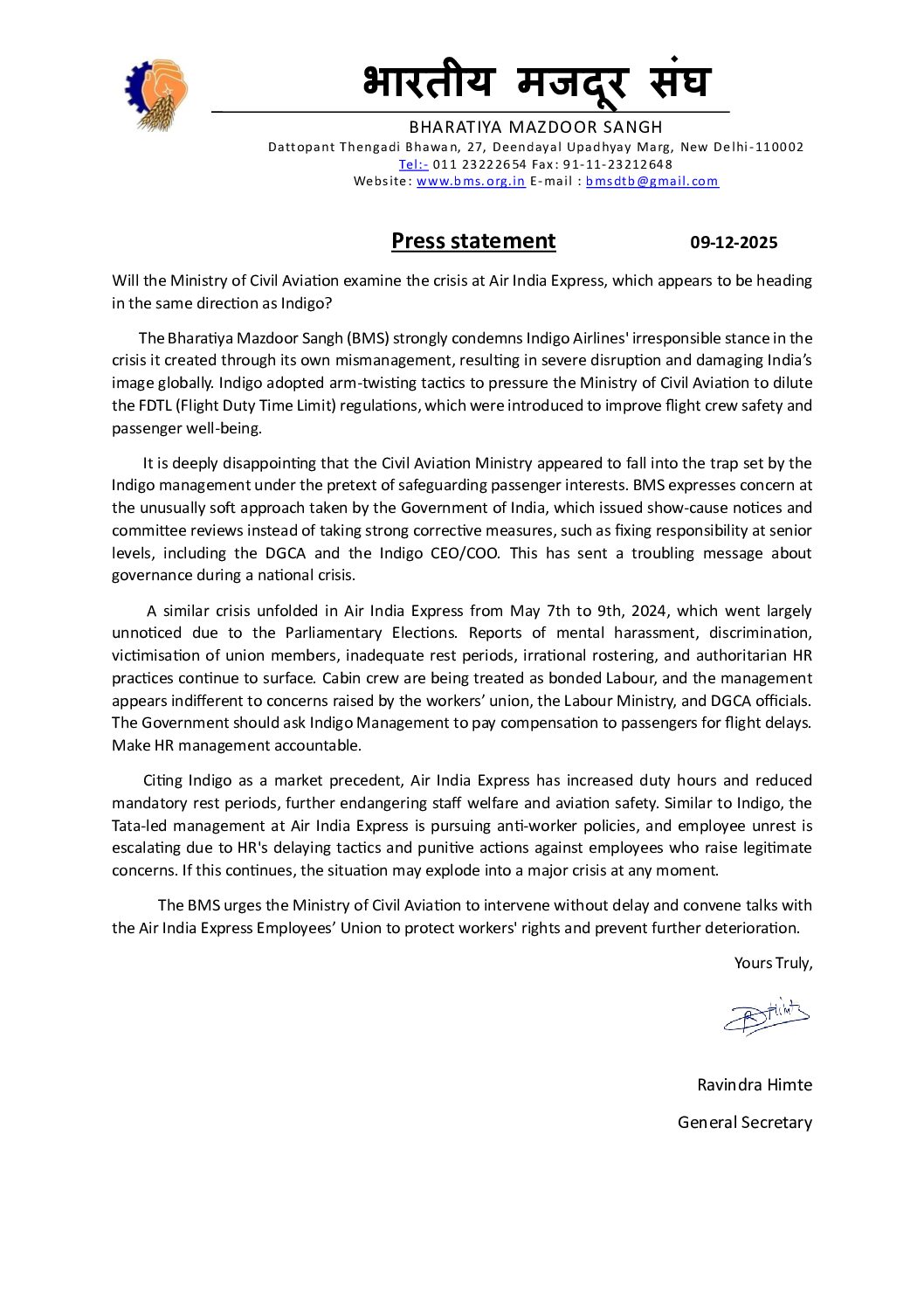
” Like Indigo Chaos, Air India Express had also experienced such a crisis on 7-9 May 2024, which went unnoticed due to the Parliamentary Elections. Mental harassment, discrimination, victimisation of sole Cabin Crew Union members, lack of rest, adoption of an illogical roster system, authoritarian approach of HR group, treating Cabin crew as bonded labourers are day-to-day affairs in Air India Express. The Management neither cares about the Union nor the Labour Ministry’s top officials or DGCA authorities.

“Showing the wrong practices of Indigo as market trend”, the Air India Express has increased working hours and reduced rest hours between two flights. BMS requests the Ministry of Civil Aviation to intervene immediately and hold talks with the Air India Express Employees’ Union to avoid any unpleasant development “

Shri B. Surendran, All India Organising Secretary of Bharatiya Mazdoor Sangh, joined the pre-budget consultations with central trade unions, Organised by the Ministry of Finance, at Kartavya Bhawan, in the presence of Hon’ble Finance Minister, Smt. Nirmala Sitharaman, Hon’ble MoS for Finance, Sh. Pankaj Chaudhary, Secretary – Department of Economic Affairs, Secretary – Labour and Employment, Chief Economic Advisor, joint secretaries from MoFA & MoLE and representatives from all Central Trade Unions and Employers’ Organisations.

BMS has appreciated the government’s proactive approach and two significant decisions taken last year in the form of tax relaxation for the middle class – a key demand of BMS in the previous two years and constituting the 08th CPC and constitution of the 08th Central Pay Commission.

Further, BMS has raised issues of unorganised sector workers, the provision/enhancement of social security measures, and advised the government to focus on labour-intensive sectors, including beedi, plantation, sanitation, the fisheries sector, and gig & platform sectors.

We have urged the government to focus on the Unorganised sector, especially the regularisation of 28 lakh Aanganwadi workers and helpers, 10 lakh ASHA workers & 25.7 Lakh mid-day meal workers, along with other scheme workers. Further, we have also advised the government to raise MNREGA workdays from 100 to 200/family and link it with agriculture and village industries.

BMS has asked the government to increase the minimum pension from Rs. 1000 to Rs. 7500 and link it to the Consumer Price Index to ensure minimal impact of inflation on pensioners. BMS has also emphasised the need to raise the ESI wage ceiling from Rs. 21000 to Rs. 42000, the EPF ceiling from Rs. 15000 to Rs. 30000, and the Bonus calculation limit from 7000 to 14000, and also link them to CPI. Increase premium and insurance benefits under the Central Govt. Employees Group Insurance Scheme (CGEGIS).

We have suggested setting up Vishwakarma centers for skilling/upskilling and providing financial support, etc., in self-employment sectors such as blacksmithing, pottery, carpentry, etc. BMS has also suggested “Gau Vigyan & Veterinary Kendra” alongside Krishi Vigyan Kendras (KVKs) to facilitate cattle rearing and income generation in rural India.

To increase employment opportunities in rural India, we have suggested setting up a solar energy policy that allows marginal land holders from SC/ST/OBC/Women community holding 2-5 Acres of land, to set up solar power plants in their fields with capital support in the form of subsidy and cheap loans from the GOI. We have also proposed increased support for street vendors by increasing the PM SVAnidhi allocation and supporting urban local bodies in setting up mobile carts with solar-powered lights and seating.

BMS has strongly urged the government to implement the Code on Wages and the Code on Social Security at the earliest possible time to ensure that its well-intentioned benefits reach workers. On the other two codes, we have asked the government to Organise compulsory consultations with trade unions, as some of the provisions are not worker-friendly.

We have also demanded that production in select NTC mills be restarted at the earliest and that the pending wages of workers be paid at the earliest. Wage dues in different PSUs like HEC, HMT, RINL etc. should be cleared urgently.

We hope the government will take the necessary steps to improve workers’ welfare.

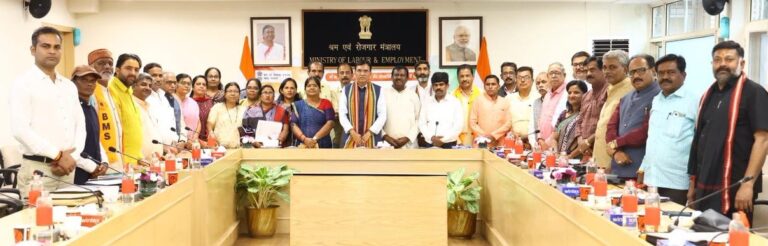
In response to the demands raised by 15 Unorganised Sector Federations affiliated with the Bharatiya Mazdoor Sangh (BMS), the Union Minister for Labour and Employment, Dr. Mansukh Bhai Mandaviya, affirmed that the Government of India is fully committed to extending Social Security coverage to all unorganised sector workers, calling it the top priority of the Government. भारतीय मजदूर संघ (बीएमएस) से संबद्ध 15 असंगठित क्षेत्र में कार्यरत महासंघों द्वारा सौंपे गए मांगों के जवाब में, केंद्रीय श्रम एवं रोजगार मंत्री डॉ. मनसुख भाई मंडाविया ने कहा कि भारत सरकार सभी असंगठित क्षेत्र के श्रमिकों को सामाजिक सुरक्षा कवरेज प्रदान करने के लिए पूरी तरह प्रतिबद्ध है और इसे सरकार की सर्वोच्च प्राथमिकता बताया। डॉ. मंडाविया ने नई दिल्ली में भारतीय मजदूर संघ के एक उच्च-स्तरीय प्रतिनिधिमंडल के साथ बातचीत के दौरान यह आश्वासन दिया।
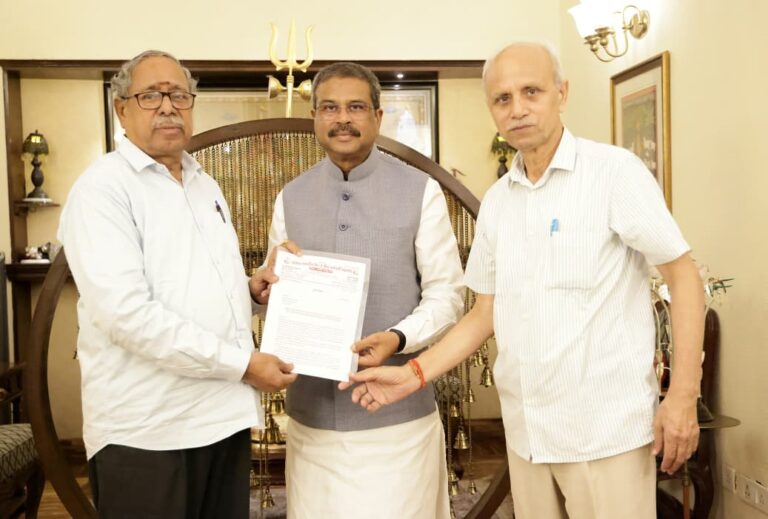
The BMS delegation met the Honourablee Union Education Minister, Sri Dharmendra Pradhan, and submitted a memorandum on the problems faced by Mid-Day Meal workers throughout the country. The delegation has been briefed on the sufferings of these workers, who face low wages, multiple responsibilities, inadequate health facilities, and harassment by Supervisory staff and the District Administration.
The delegation, led by Sri B. Surendran, All-India Organising Secretary, BMS, and Sri Ashok Shukla, All-India Secretary, BMS. The delegation brought to the Minister’s notice the low honorarium paid to MDM workers. The BMS has demanded Rs 10000/ as a monthly honorarium. It informed the Minister that in many places, the MDM Workers are forced to perform tasks such as school sweeping, Watchmen, office boy, and Cooking. In many States, district officials will not provide sufficient rations to Students. In a few states, such as Madhya Pradesh, Self-Help Groups have been assigned this work. For them, reimbursement of expenditure will not be made; the poor women have to wait for months together.
The Akhil Bharatiya Mid-Day Meal Karmachari Mahasangh, an Industrial Unit of Bharatiya Mazdoor Sang,h had organised a demonstration on 1st July at around 400 Places, highlighting the problems faced by them. They have sent a memorandum to the Hon. Prime Minister and the Hon. Education Minister.
The Honourable Minister, Sri Dharmedra Pradhan, has responded positively to the issues and promised to write a letter to the finance minister regarding the enhancement of monthly wages. He also promised to arrange an official meeting with the concerned officials soon.
The Hon. Minister has responded on his Twitterr and Facebook accounts about Mid-Day Meal workers’ issues
https://x.com/dpradhanbjp/status/1962464138422280473
https://www.facebook.com/share/p/1EHyHjyQhn/
BMS sincerely expresses its heartfelt thanks to the Minister for patiently hearing and responding positively.
A high-level delegation of the Bharatiya Mazdoor Sangh (BMS) met Shri Pratap Rao Jadhav, Honourable Minister of State for Health & Family Welfare and AYUSH, urging immediate and high-priority action to resolve the pressing issues faced by ASHA workers in the Andaman & Nicobar Islands.
The delegation highlighted several long-standing grievances, including the absence of TA/DA for official meetings or additional work, non-payment of uniform allowances and telephone reimbursements, and increasing instances of undue pressure and mental harassment. ASHA workers are being compelled to work fixed hours in PHCs/CHCs while also being told to remain available round-the-clock – a clear violation of the scheme’s norms.
It was also pointed out that, until March 2025, the Andaman & Nicobar Administration provided an additional 500 as a Union Territory share, in addition to the 2,000 monthly honorarium. This UT share has been discontinued since April 2025, resulting in a reduction of ASHA workers’ monthly income to just 2,000.
The BMS delegation strongly demanded a grant of a Remote Location Allowance of 2,000 per month, considering the difficult geography and unique working conditions of the Islands; enhance the monthly Honorarium as per the changing prices in the Island; Immediate end to mental harassment, with ASHA duties restricted strictly to those defined under the scheme; Clearance of all pending TA/DA payments across the three districts; timely provision of uniforms and raincoats; and effective implementation of the Ayushman Bharat Yojana in the Islands.
The delegation was led by Shri B. Surendran, All-India Organising Secretary, BMS, along with Shri S. Mallesham, All-India Vice President, and Shri Ganesh Mishra, All-India Deputy Organising Secretary.
The Honourable Minister responded positively, acknowledging that ASHA workers in the Islands deserve special consideration due to their smaller population base and exceptional working conditions. He assured the delegation that he would take up the matter with the concerned authorities and initiate necessary action at the earliest.
The new GST reforms introduced by the Finance Ministry represent a significant step towards a people-friendly and common man-oriented tax structure. Traditionally, the indirect tax regime was heavily reliant on taxing the day-to-day needs of the citizens. This trend has now been reversed through the next-gen reforms, which introduce a primarily two-rate GST system aimed at reducing the tax burden on the people, while imposing higher taxes on luxury goods consumed by the high-income group. BMS welcomes the reduction of taxes on labour-intensive industries, essential daily use consumer goods, cement, food items, healthcare products including insurance policies, educational materials, agricultural machinery and other inputs, automobiles, electronic appliances, and other items commonly used by the middle class and below. We also hope that manufacturers, insurance companies and others will promptly pass on these benefits to the common man by lowering the prices of essential daily-use products.
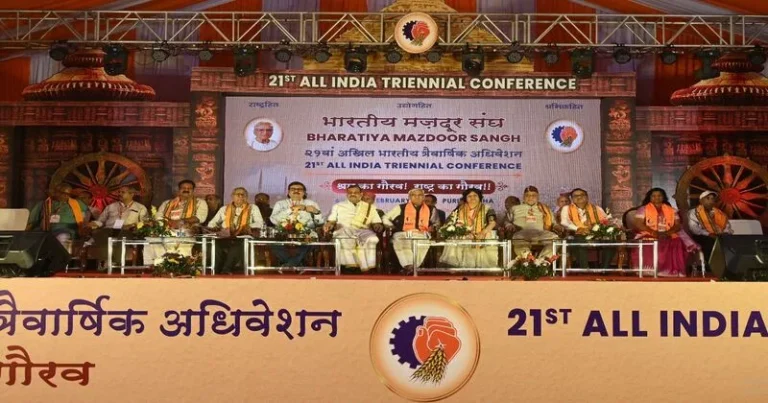
Bharatiya Mazdoor Sangh Implement the Wage Code and Social Security Code immediately – BMS. The 159th Kendriya Karya Samithi (Central Executive Council) of Bharatiya Mazdoor Sangh has demanded the Central Government to implement the Wage Code and Social Security Code immediately. The KKS meetings also demanded that the Government of India convene the Indian Labour Conference (ILC), the highest tripartite body of the Labour Ministry, at the earliest date. The KKS meetings of BMS were held from August 22 to 24, 2025, in Bhopal, and adopted three resolutions. Sri Hiranmay Pandya, President, chaired the deliberations, and Sri Ravindra Himte, General Secretary, conducted them. The Wage Code and the Social Security Codes are the historical ones that are more beneficial to ordinary workers. Therefore, BMS continuously insists on immediate implementation. The BMS is opposing many clauses that are against Workers’ interests in the Industrial Relations Code and also the Occupational Safety & Health and Working Conditions Code. Hence, it is opposing these two codes. BMS requests the Government of India to implement the Labour Codes in a phased manner, taking the tripartite partners into confidence. There should not be any haste in implementing all four Labour Codes. The Indian Labour Conference (ILC) was held in 2015. After that, it was not held. The ILC is the highest Tripartite Body under the Labour Ministry, which is one of the best contributions of Indian Democracy. After 2015, the world of work has undergone significant changes in multiple dimensions. Technology, Digital Infrastructure, and Digital transition have brought about many changes in Social life and the economic scenario. There is an urgency to discuss Labour issues in this highest decision-making body. The Labour Ministry should take the initiative and convene the ILC as early as possible. The KKS meetings, through a resolution, had welcomed the Haryana Government’s decision to regularise contract workers under the Kaushal Vikas Yojana. They expressed their gratitude to the Chief Minister of Haryana, Sri Nayab Singh Saini. The KKS had expressed its apprehensions about the Face Recognition System (FRS) introduced by the Women and Child Welfare Ministry under the ICDS scheme. The FRS has presented numerous difficulties for Aanganwadi Workers nationwide due to several practical problems at the implementation level. It has become another tool for harassing Aanganwadi Workers by District-level officials. The BMS demanded that the government withdraw this lopsided policy. The KKS has decided to conduct its 20th All-India Conference in Puri during the first week of February 2026, with approximately 2,500 selected delegates from 42 Industrial Federations and 28 State units.
“Bharatiya Mazdoor Sangh’s (BMS) year-long celebration is not just been a ritual, it is a moment to look back and introspect: how BMS began, what motivated it, what it achieved, and what lies ahead. This is not just a commemoration, but a movement powered by values and vision,” said Rashtriya Swayamsevak Sangh Sarsanghchalak, Dr Mohan Bhagwat at concluding programme of 70th Foundation day of Bharatiya Mazdoor Sangh (BMS) on July 23, 2025, at the KD Jadhav Wrestling Hall, Indira Gandhi Stadium, New Delhi. “When Dattopant Thengadi ji founded this organisation under the name of Mazdoor Sangh, he often visited several labour organisations. BMS was very small at that time. People from other unions used to mock and say, ‘Your saffron flag cannot rise in this field.’ They questioned our ideology of ‘Workers, Unite the World’—saying how can labourers even think like this? But today, 70 years later, Thengadi ji’s vision stands vindicated. And that has been made possible by the tireless efforts of BMS karyakartas.” Narrating an anecdote, he said, “In 1980, at a BMS convention, Dr MG Gokhale, a known communist, attended the event. A RSS shakha used to happen in front of his house, and through that interaction, he began resonating with Sangh’s thoughts. He once remarked that BMS is the only organisation with a complete vision but does not have a system. Dattopant ji humbly agreed and responded that our ideology may be good, but our working methodology is not yet fully aligned to it, as the systems we operate are not upto mark. We need to correct the system so that our ideology and action align. Today, we are finally arriving at that stage,” Dr Bhagwat said. He added, “In Sanatan Dharma, one of the four pillars of life is Parishram (hard work). BMS has strived to offer the world a new, eternal model. As times change, we must develop and present a model suited to this era. This requires a balanced approach, just like the first generation began the work, the second maintained it, and now the third and fourth generations must understand why and how they continue it.” Recalling another anecdote, he shared, “When Dattopant ji was elected to Rajya Sabha, he asked Guruji, then Sarsanghchalak of RSS (MS Golwalkar), ‘What should I do for the workers now?’ Guruji replied, ‘Just as a mother holds affection for her child, if you carry that emotion and work closely with labourers, you will succeed.’ Work that is sustainable and rooted in emotion, not driven by convenience, leaves a lasting impact. That emotion and inspiration must be carried forward’. “Thengadi ji worked in other labour organisations to learn the work, that organisations can also work, but they lacked the right ideological foundation. BMS was founded on the principles of Rashtra Hit, Udyog Hit, and Majdoor Hit. That is why it has now become an example for the entire world,” he said. Dr Bhagwat further reflected, “Today, questions that were not even raised 50 years ago are now in front of us. The unorganised sector is vast and even within the organised sector, many remain unorganised. We must work to restore their self-respect and dignity. The nature of work varies by region; hence, our action must adapt to the ground realities with proper coordination.” Speaking about technological advancement, he said, “Technological transformation is another challenge. Every new technology brings concerns, will it led an increase in unemployment? Will it dehumanise us? Once, people walked miles, then came bicycles. In my childhood, having a cycle to go to school was a big deal. Today, without a car, people hesitate to move. Knowledge based technology needs to be thought about with the new perspective- the impact of technology on the field. It can devalue the prestige of Shram – Labour. Technology can’t be rejected- so it has to be customised as per the need of the society and interest of the Labour field. Reduced physical labour cannot be an excuse to shun hard work. We cannot stop the use of technology, but we must harness it wisely so that society at large benefits. BMS is the largest labour organisation in the world, and it has the responsibility to ensure that every emerging situation benefits all sections of society. The world is watching BMS, and it must rise to this responsibility. How to integrate the Labour, Industrial and national interest in the age of technological transformation is the biggest challenge for tomorrow.” “As we move ahead with confidence in our capabilities and clarity in our goals, we must keep in mind that BMS now bears the responsibility to bring about transformation not just in the nation, but across the world. Success should not be the end. Julius Caesar is remembered for ‘He came, he saw, he conquered’—but he died in the height of his glory. World-conquerors are often forgotten. But the one who gave up his kingdom for 14 years and went into Vanvas, Ram, is still remembered. That is why he is Parbhu Ram.” A special edition of ‘Organiser Weekly’ magazine titled ‘Laborious Resetting’ was also released by Dr Mohan Bhagwat. Union Minister for Labour and Employment, Government of India, Shri Mansukhbhai Mandaviya, who was also the Guest of Honour said, “The working style of BMS is deeply rooted in the ethos and foundational values of Bharat. While we regularly meet with various labour organisations, the work culture and approach of BMS always stand out and offer much to learn. BMS has rightly recognised that a labour movement is not merely a force for protest, but a force for nation-building.” He further said, “BMS is perhaps the only organisation that not only confronts labour issues and struggles for workers’ rights but also ensures tangible outcomes. When a 30-member Indian delegation participated in the ILO, it was BMS that led it with dignity and vision.” “During the COVID-19 crisis, many around the world doubted Bharat’s health infrastructure. But we managed the pandemic with a uniquely Bharatiya model. Some questioned symbolic gestures like clapping and lighting lamps—but those were to honour our corona warriors. That spirit of collective respect and unity was integral to our response,” he said. “In our country workers don’t operate merely on the basis of fixed hourly contracts. They work beyond limits—not out of compulsion, but as a contribution, a sense of shared responsibility. That spirit of cooperation and sacrifice lies at the heart of Bharat, and organisations like BMS reflect and strengthen it,” Mandaviya asserted. Presenting an overview of the 70-year journey of Bharatiya Mazdoor Sangh (BMS), Ravindra Himte, General-Secretary, BMS, said, “BMS has completed 70 meaningful years of service to the nation. I pay my heartfelt tributes to all those great personalities who dedicated their entire lives to this organisation. During this period, BMS has consistently worked in the interest of the nation, industry, and labour.” He added, “On July 23, 1955, the very day BMS was founded, we resolved that every decision of the organisation would be taken collectively. For the last seven decades, we have been steadfast in upholding these values” He informed that beginning in August 2025, BMS organised a five-month-long lecture series at the district level across the country, focusing on five core themes to generate mass awareness among karyakartas and society at large. Starting from December, a ‘Shramik Sampark Abhiyan’ was undertaken to directly engage with workers. This was followed by district-level Women’s and Youth Conferences in February–March 2025, which witnessed enthusiastic participation of women and young workers across the nation. BMS has also raised awareness about the ‘Panch Parivartan’ initiative. BMS President Hiranmay Pandya said, “This gathering is not just to commemorate the 70-year journey of Bharatiya Mazdoor Sangh, but also to chart the course for the future. When we began in 1955 with the principle of ‘Rashtra Hit, Udyog Hit, and Majdoor Hit’, some questioned how labourers’ interests could be served if placed third. Today, BMS stands as the largest labour organisation in the country, unwaveringly working in the interest of workers.” “The organisational work of BMS is active in 30 prants across the nation. At a time when many believed that the era of trade unions was over, BMS has continued to grow, getting over 150 unions recognised every year. In the ILO, 50 per cent of the representation was of women from India due to the efforts of BMS,” he stated. He further added, “Till 1981, BMS was the second-largest trade union in India. By 1989, without any division or disruption, BMS emerged as the largest. It is not just a labour organisation, but a thought-driven ideological movement committed to national development and worker empowerment.” “We have shown the world that labour protest is not merely about raising slogans—it is about constructive nation-building,” Pandya asserted. “Our next milestone is BMS@100, and we are determined to move forward with renewed vigour and commitment.” Palak Adhikari of BMS, V. Bhagaiah ji, said, “Participating in the 70-year celebration of BMS is not just a moment of joy and pride for all of us, but a moment that instills a deep sense of responsibility. This is not merely an event; it is an embodiment of an ideology, a successful journey, and a transformative movement. This is not just a programme of BMS, but of the entire society.” He elaborated, “After the advent of Western ideologies in India, a sense of mistrust was instilled in the minds of workers towards employers. However, according to Bharatiya tradition, whether an artisan is in the organised or unorganised sector, BMS has always stood by the principle of working in the interest of the nation and ensuring full and fair compensation for their labour. Working for the nation is the duty of the worker; receiving due wages is their right.” “While other organisations say ‘Workers of the World, Unite!’, BMS says, ‘Workers, Unite the World!’ This is the Bharatiya perspective. Shukr Niti mandates that after 40 years of service, a worker must be given a proper economic security for the rest of his life. BMS has worked tirelessly for this cause. Unfortunately, due to ideological bias, the communists deliberately erased this from public memory,” he said. “But it is BMS, that through its relentless efforts it has ensured dignity for labour, economic stability for workers, and their right to justice. The credit for this transformation goes to Bharatiya Mazdoor Sangh, For BMS nation is first,” Bhagaiah ji asserted. Indu Jamwal, President, Delhi Unit of BMS, welcomed all dignitaries, karyakartas, and the foreign delegation present on the occasion. She urged the karyakartas to work with greater dedication to strengthen the organisation and take BMS to newer heights in the service of the nation. “From workers of the World Unite to Workers Unite the World – in 70 years, BMS has changed meaning of Labour Organisation”, she said. On this occasion, BMS felicitated several of its senior activists, including: Geeta Gokhale (Mumbai), Hansubhai Dave (Rajkot), Sama Balreddy (Hyderabad), Vasant Pimplapure (Nagpur), Amarnath Dogra (Delhi), Sardar Kartar Singh Rathore (Punjab), Haji Akhtar Hussain (Bulandshahr, Uttar Pradesh), Mahesh Pathak (Railways, Delhi), and several other senior karyakartas. On this occasion, BMS, President Hiranmay Pandya launched a new digital app, ‘E-Karyakarta’ to keep records and information about its karyakartas, work and strengthen internal communication. Additionally, a documentary film based on the 70-year journey of the BMS was screened. The grand event also witnessed the participation of Senior RSS Functionaries including Alok Kumar ji, Sunil Ambekar ji, State Presidents and General Secretaries of BMS, Federation Leaders, members of the extended National Executive Committee, a 11-member delegation from Nepal, Union Minister Harsh Malhotra, Delhi Mayor, Raja Iqbal Singh, Delhi Speaker Vijendra Gupta, Chief Minister, Rekha Gupta, Cabinet Minister Kapil Mishra and many other eminent personalities including Harbhajan Singh Sidhu were also present. The live telecast of this event was shown at 110 locations through zoom, YouTube live.
Urges Assurance of Quality Employment, Worker Protections and Priority to Micro & Small Industries.
The Bharatiya Mazdoor Sangh (BMS) has urged all national governments to establish Artificial Intelligence (Al) regulatory mechanisms to safeguard workers from job displacement and enhance productivity. This demand was made during the International Congress on Labour Digitalization and Social Justice, held in Ankara, Turkey, from April 18th to 21st, 2025.
The high-level BMS delegation, led by General Secretary Sri Ravindra Himte, emphasised the need for regulations covering Artificial Intelligence, Machine Learning, and the Internet of Things (IoT). The BMS acknowledged that while modern technology offers undeniable benefits and can make life easier, it also poses a serious threat to the workforce due to its increasingly impersonal and inhuman impact.
A six-member delegation from India, representing three major Central Trade Union Organisations Viz. Bharatiya Mazdoor Sangh (BMS), Trade Union Coordination Centre (TUCC), and National Federation of Independent Trade Unions (NFITU)-participated in the Congress, which Memur-Sen, a central trade union of Turkey, organised.
More than 200 delegates from 36 countries, including distant nations such as China, Thailand, and several Caribbean countries, took part in the event. Prof. Burhanettin Duran, Hon. Deputy Minister of Foreign Affairs, Republic of Turkey, formally inaugurated the Congress on April 18th. Dr. Vedat Işıkhan, Hon. Minister of Labour, Republic of Turkey, addressed the delegates as a special guest on the second day. Mr. Ali Yalçın, President of Memur-Sen, presided over the sessions.
The Congress featured four plenary sessions and four panel discussions focused on critical and timely issues.
The first panel on “The Impact of Globalization and Digitalization on the World of Work was moderated by Mr. Valentine Okechukwu Udeh, Assistant Secretary of OATUU, Ghana.
The second session on “Ensuring Social Justice in the Workplace and Addressing Income Distribution” was led by Mr. Mochamad Djumhar Hidajat, President of KSPSI, Indonesia.
The third session on “Organizational Diversity, Global Solidarity, and Sustainable Labour Relations” was moderated by Mr. Surendran Bojji, All India Organising Secretary, BMS, India.
The final panel, “The Impact and Transformation of Digitalization on Trade Union Structures”, was moderated by Mr. Rolland Herman Ignacio, Secretary General, ADS of Caribbean Countries.
During the plenary sessions:
Sri Ravindra Himte (BMS) spoke on safeguarding labour interests in the digital era.
Sri S.P. Tiwari (TUCC) addressed the issue of growing income inequality and proposed solutions.
Dr. Virat Jaiswal (NFITU) highlighted the responsibility of national governments to implement sustainable labour relations effectively.
The Congress concluded with the adoption of a seven-point resolution titled the “Ankara Declaration on Labour, Digitalization, and Social Justice.”
The BMS delegation met the HE Indian Ambassador of Turkey, Sri Muktesh Pardesi, at the Indian Embassy in Ankara. They held fruitful discussions on the status of Indian Migrant labour working in different Islamic Countries. Sri Muktesh Pardesi was the Special Secretary of G 20-India programmes. He guided BMS during different events of Labour 20 under G20 India.
(Ravindra Himte)
General Secretary